







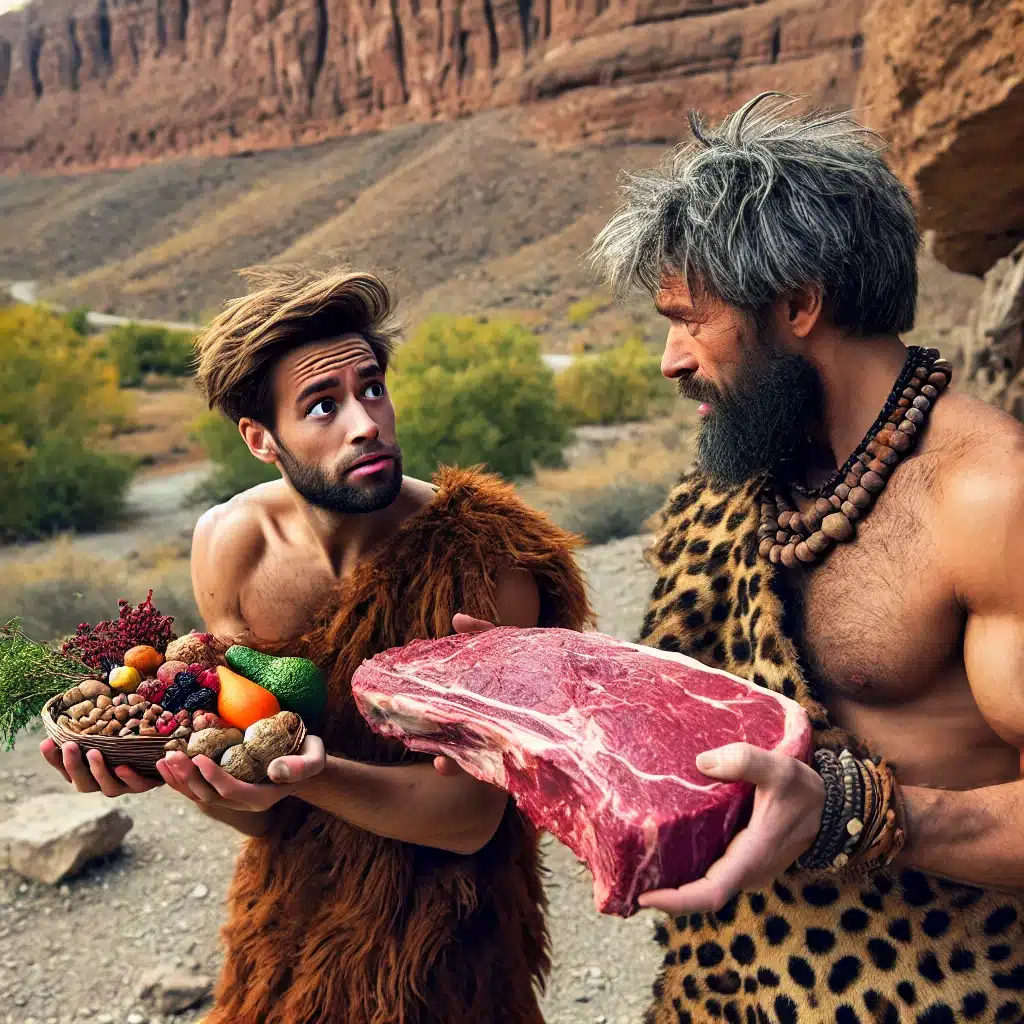
Did Cavemen Really Eat Only Meat? The Ancient Poop Says Otherwise! 💩😂
Ah, the age-old image of the caveman: a burly figure brandishing a club in one hand and a mammoth drumstick in the other. 🍖🔨 But what if I told you that this portrayal is more “Flintstones” fiction than fact? 🦴🦕
Recent research has unearthed solid (sometimes literally 💩) evidence that our prehistoric ancestors had a diet far more varied than a carnivore’s cookbook. So, let’s embark on a journey through time to debunk the myth of the meat-only caveman, with a sprinkle of humor and a heap of science. 🧬🧐

The Scoop on Ancient Poop 💩🔬
One of the most telling pieces of evidence about ancient diets comes from an unlikely source: fossilized feces, or as scientists endearingly call it, “paleofeces.” 🤢 Yep, we’ve been digging through ancient poop to understand what our ancestors ate—because science is just that glamorous. 👨🔬🦠
🔍 A study of Neanderthal feces from El Salt, Spain revealed that these so-called carnivorous cavemen actually ate a lot of plants! 🌿🥜 Their poop contained evidence of nuts, berries, tubers, and even mushrooms. 🍄 This means their diets weren’t just meat-heavy—they were well-rounded and diverse. 🥦🌽
🔗 Source: https://www.science.org/content/article/neandertals-ate-their-veggies-their-feces-reveal
Caveman Dental Records: More Than Just Meat Stuck in Teeth 🦷🍃
Since our ancestors didn’t have the luxury of dental floss or Colgate, their teeth preserved tiny bits of whatever they ate. 🤭 And guess what? Their dental plaque tells us they weren’t just gnawing on dino ribs. 🦖🚫
🔬 Neanderthal teeth from Belgium contained remnants of pine nuts, moss, and wild mushrooms—not exactly what you’d expect from a supposed hardcore carnivore. 🌰🌱
🔍 Another study of ancient human teeth in Israel (Ohalo II site, 23,000 years ago) showed evidence of wild barley, fruits, and seeds, further proving that humans have always been opportunistic eaters, not meat-exclusive predators. 🍓🌾
🔗 Sources:
https://www.science.org/content/article/neandertals-ate-their-veggies-their-feces-reveal
https://www.nature.com/articles/s41559-024-02382-z
https://en.wikipedia.org/wiki/Ohalo_II
Gatherers Outnumbered Hunters 🥜🍒
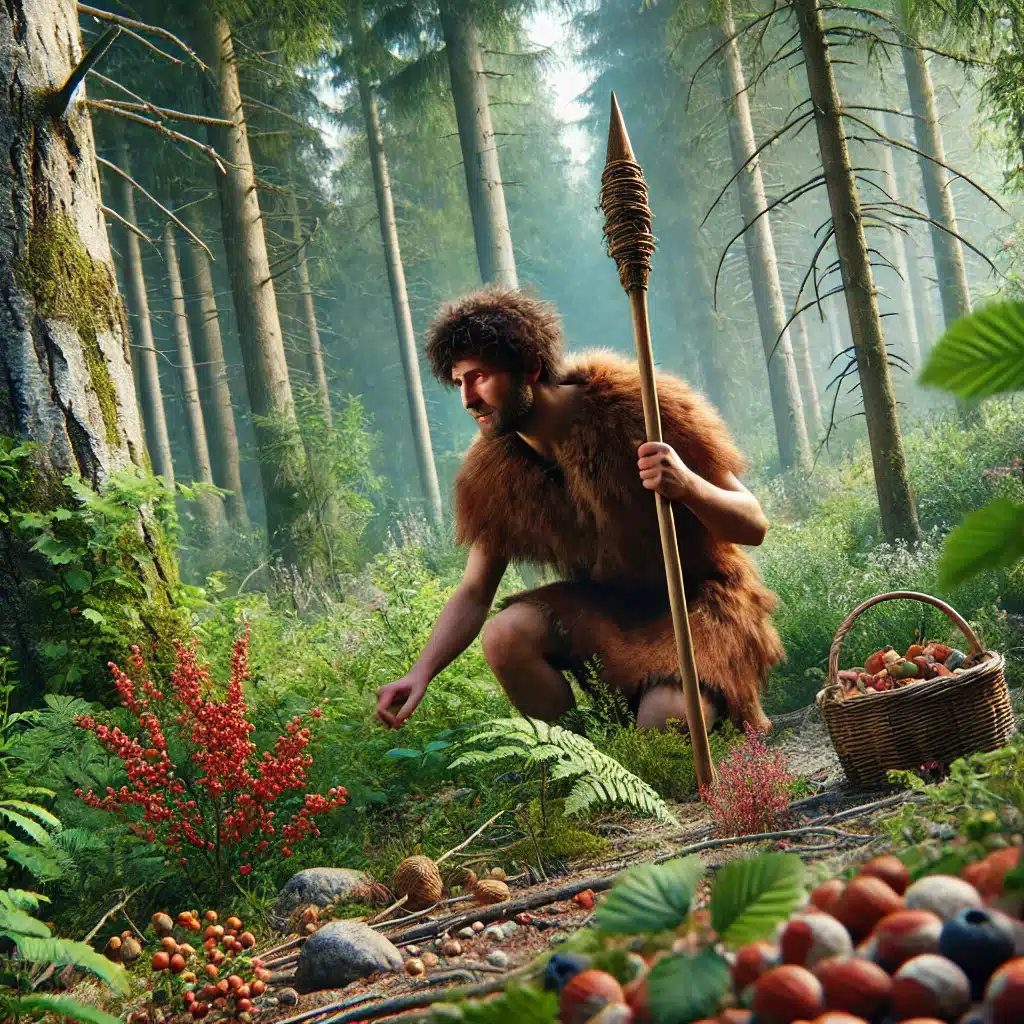
Let’s get real for a second. Hunting a mammoth was HARD. 🐘🔥 Imagine trying to take down a five-ton hairy beast with a wooden spear—not exactly an everyday event. 😅 Hunting was risky, dangerous, and often unsuccessful. So, what did early humans do in between mammoth rodeos? They gathered whatever they could find! 🥕🍎
Foraging made up the majority of their diet because:
✅ It was reliable—plants didn’t run away. 🌾🏃
✅ It was safer—no getting trampled by an angry bison. 🦬💀
✅ It was nutritious—fiber, antioxidants, and vitamins, oh my! 🍊🥦
This explains why prehistoric people had the digestive systems to process plant-based foods, which we still have today. If we were meant to eat only meat, we’d have shorter intestines like lions 🦁—but we don’t.
The Meat-Only Myth: Born From Bro Science 🏋️♂️🤦♂️
So where did this “cavemen were pure carnivores” myth come from? 🤔
1️⃣ Early archaeologists misunderstood the fossil record—animal bones last longer than plant remains, so they assumed meat was the main food source.
2️⃣ The 20th-century obsession with masculinity glorified meat-eating as a sign of strength. 🍗💪
3️⃣ Modern carnivore diet influencers love pushing the idea that eating like a caveman means devouring steaks 24/7. (Spoiler: it doesn’t.) 🥩🚫
The truth? Cavemen ate what they could get their hands on, and that was often A LOT of plants. 🌱
Survival vs. Longevity: Cavemen Didn’t Live Long Anyway ⏳💀
Here’s another fun fact: cavemen weren’t exactly longevity experts. The average lifespan? Around 30 years. 😬 So, eating for “optimal health” or “anti-aging” wasn’t exactly on their agenda.
They ate whatever they could to survive—not to be 100-year-old CrossFit champions. 🏋️♂️🥦 If they had access to calories, they ate them. That meant meat when possible, but mostly plants, nuts, and roots. 🌰🍠
The idea that humans evolved to thrive on a high-meat diet is nonsense—they simply ate whatever kept them alive. If that meant living off berries and roots for weeks, so be it. 🍇🫛

The Takeaway: Cavemen Weren’t Keto Bros 🚫🥓
🔹 Cavemen ate a lot more plants than people think—confirmed by poop, teeth, and archaeological digs. 💩🔬
🔹 They weren’t concerned about macros or “optimal diets”—they were just trying to avoid starving to death. 🏹😅
🔹 Hunting was risky and unreliable, so gathering was the backbone of survival. 🌾🥜
🔹 Claiming that “cavemen only ate meat” is just modern-day misinformation pushed by diet culture. 🚫🐂
Final Thought: Want to Eat Like a Caveman? Eat Plants! 🌿💚
If you really want to “eat like your ancestors,” you should be feasting on nuts, tubers, berries, greens, and grains—not pretending you’re a saber-toothed tiger. 🐅🥩🚫
So the next time someone tells you “cavemen were all about the meat,” send them this article, tell them to check the poop science, and enjoy a plant-based meal in peace. 🥗😆

📚 Scientific Evidence: What Early Humans Really Ate
Claims about early humans being “meat-based carnivores” collapse when examined against the actual fossil, biochemical, and anatomical evidence.
Below are peer-reviewed scientific studies used to evaluate early human diets using multiple independent lines of inquiry.
🦷 Dental Wear & Microwear Analysis
Dental wear patterns provide direct insight into long-term dietary behavior.
Early hominin teeth show abrasive wear consistent with fibrous plant foods rather than flesh-tearing carnivory.
- Ungar, P. S., et al. (2006). Dental microwear analysis of early hominins.
Journal of Human Evolution, 50(1), 78–95. - Grine, F. E., et al. (2012). Dental evidence for diet in early Homo.
Proceedings of the National Academy of Sciences (PNAS), 109(17), 6868–6873.
🧪 Stable Isotope Analysis (Diet Composition)
Stable carbon and nitrogen isotope ratios allow researchers to estimate the relative contribution of plant versus animal foods.
Results consistently show heavy reliance on plant foods, varying by region and availability.
- Richards, M. P., & Trinkaus, E. (2009). Isotope evidence for the diets of European Neanderthals.
PNAS, 106(38), 16034–16039. - Henry, A. G., et al. (2011). Stable isotope analysis and plant consumption in early humans.
Journal of Human Evolution, 60(5), 618–626.
💩 Coprolites (Fossilized Feces)
Fossilized feces provide direct dietary evidence.
Analyses reveal plant fibers, phytoliths, and starch granules, demonstrating substantial plant consumption.
- Reinhard, K. J., et al. (2001). Diet and parasitism at prehistoric sites.
Current Anthropology, 42(4), 575–581. - Henry, A. G., et al. (2011). Microfossils in calculus demonstrate plant consumption.
PNAS, 108(12), 486–491.
🪨 Dental Calculus (Trapped Food Remains)
Dental calculus preserves microscopic food remains trapped during life.
These analyses consistently reveal plant foods, including cooked and raw starches.
- Hardy, K., et al. (2012). Neanderthal plant use revealed by dental calculus.
PNAS, 109(13), 486–491. - Power, R. C., et al. (2014). Dental calculus analysis in archaeological populations.
Journal of Archaeological Science, 48, 32–43.
🧠 Human Anatomy & Digestive Physiology
Human digestive anatomy aligns with a plant-heavy dietary pattern:
long intestines, fermentative capacity, flat molars, and reduced stomach acidity compared to carnivores.
- Milton, K. (2003). The critical role of diet in human evolution.
American Journal of Clinical Nutrition, 77(4), 849–860.
🔎 Conclusion:
Multiple independent scientific methods — dental analysis, isotope chemistry, fossilized feces, dental plaque, and anatomy — converge on the same conclusion:
early humans consumed predominantly plant-based diets with animal foods playing a secondary, opportunistic role.
Follow The Natural Life Reset


